CNG and LPG are two alternative fuels that have been used in vehicles for many years. Both can be used in appropriately designed or approved vehicles, and both can offer an alternative to conventional petrol and diesel.
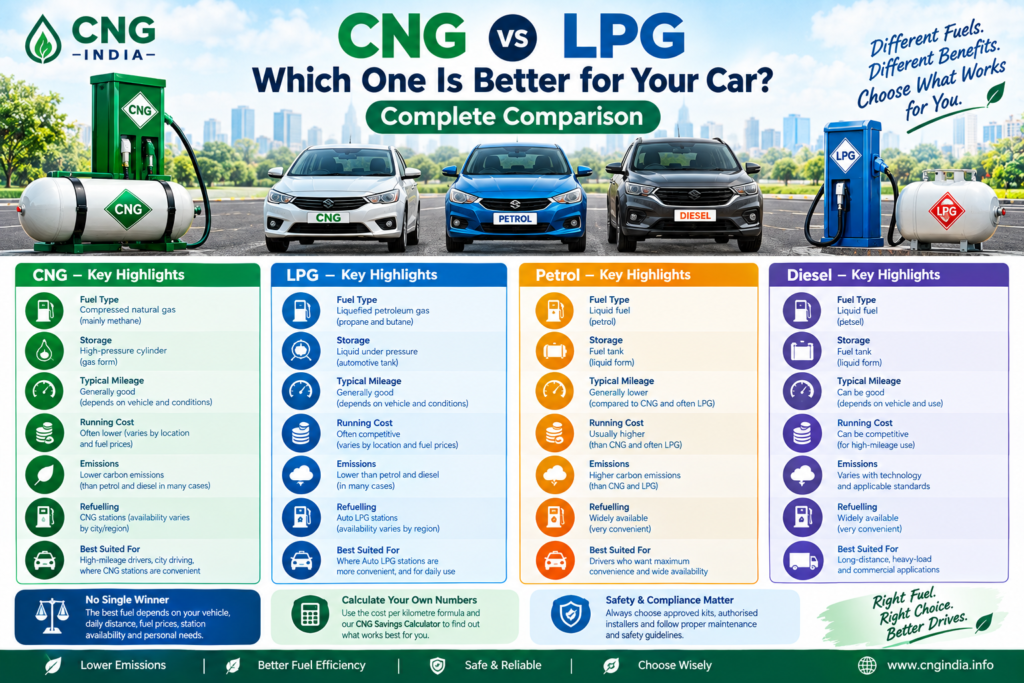
But if you are considering an alternative fuel for your car, an important question is: CNG vs LPG — which one is better?
There is no single answer that applies to every driver. The better option depends on fuel availability, running cost, vehicle compatibility, performance requirements, installation standards, maintenance and the routes you regularly travel.
In this guide, we compare CNG vs LPG on fuel type, storage, running cost, mileage, performance, emissions, safety, maintenance, refuelling convenience, conversion and practical everyday use.
What Is CNG?
CNG stands for Compressed Natural Gas. It is primarily methane-based natural gas that is compressed and stored in a vehicle’s cylinder at high pressure.
CNG is used in factory-fitted vehicles as well as approved retrofit systems for eligible vehicles. IndianOil describes CNG as an alternative automotive fuel to petrol, diesel and Auto LPG and notes that natural gas is compressed for vehicle storage.
Because CNG is stored as a compressed gas, the vehicle needs a suitable high-pressure storage cylinder and associated components such as valves, pressure regulators, fuel lines, injectors and control equipment.
Learn more in our guide: What Is CNG? A Complete Guide to CNG for Automobiles.
What Is LPG?
LPG stands for Liquefied Petroleum Gas. Automotive LPG, commonly called Auto LPG, is primarily a mixture of propane and butane.
Unlike CNG, LPG can be stored as a liquid under moderate pressure. IndianOil explains that LPG is gaseous at atmospheric pressure and normal temperature but can be liquefied under pressure, which allows a relatively large amount of fuel to be stored in a tank.
Auto LPG is different from domestic LPG used for cooking. A vehicle should use an appropriate automotive LPG system and tank; a domestic LPG cylinder should not be used as a vehicle fuel tank. IndianOil and HPCL both specifically distinguish Auto LPG from domestic LPG for automotive use.
CNG vs LPG: The Basic Difference
| Feature | CNG | Auto LPG |
|---|---|---|
| Full form | Compressed Natural Gas | Liquefied Petroleum Gas |
| Main components | Primarily methane | Primarily propane and butane |
| Storage form in vehicle | Compressed gas | Liquefied gas under pressure |
| Vehicle tank | High-pressure CNG cylinder | Dedicated automotive LPG tank |
| Typical system characteristics | High-pressure gas storage and pressure reduction | Liquid storage with vaporisation and pressure regulation |
| Refuelling infrastructure | CNG stations | Auto LPG dispensing stations |
| Retrofitment | Approved systems are available for eligible vehicles | Approved systems are available for eligible vehicles |
Both fuels have dedicated automotive systems. They should not be treated as interchangeable merely because both are gases under certain conditions.
CNG vs LPG: Which Fuel Costs Less to Run?
Running cost is one of the main reasons people compare CNG and LPG.
However, the price displayed at a fuel station does not by itself tell you which fuel is cheaper for your vehicle.
The more useful calculation is:
Fuel cost per kilometre = Fuel price per unit ÷ Real-world mileage
For example, suppose a driver records the following illustrative figures:
- CNG price: ₹80 per kg
- CNG mileage: 22 km per kg
- Auto LPG price: ₹60 per litre
- Auto LPG mileage: 15 km per litre
The approximate running cost would be:
- CNG: ₹80 ÷ 22 = approximately ₹3.64 per km
- Auto LPG: ₹60 ÷ 15 = ₹4.00 per km
In this example, CNG would have the lower calculated fuel cost per kilometre.
These figures are only an illustration and are not current nationwide fuel prices or guaranteed mileage. Your actual result can be different because fuel prices and vehicle mileage vary by location, vehicle and driving conditions.
You can use our CNG Savings Calculator to calculate your estimated CNG running cost.
CNG vs LPG: Mileage Comparison
There is no single mileage figure that applies to all CNG or LPG vehicles.
Mileage depends on several factors, including:
- Vehicle model
- Engine capacity
- Engine condition
- Fuel-system design
- Calibration
- Traffic conditions
- Driving style
- Tyre pressure
- Air-conditioning use
- Passenger and luggage load
- Road conditions
Therefore, claims such as “CNG always gives X km/kg” or “LPG always gives X km/litre” should not be treated as universal facts.
The best comparison is based on your actual vehicle’s real-world fuel consumption and local fuel prices.
CNG vs LPG: Which Gives Better Fuel Economy?
Fuel economy and fuel cost are related but they are not exactly the same thing.
A vehicle may consume different quantities of CNG and LPG because the two fuels have different physical properties and are measured differently.
Instead of comparing only kilometres per kg with kilometres per litre, calculate the cost of travelling 100 km.
Cost for 100 km = Fuel cost per kilometre × 100
This gives a much more meaningful comparison for an actual vehicle owner.
CNG vs LPG: Performance
Performance is another area where neither fuel should automatically be declared the winner.
The performance of a gas-fuelled vehicle depends heavily on the engine, fuel system, calibration and vehicle design.
A correctly installed and calibrated system can provide satisfactory everyday performance. A poorly matched or poorly calibrated system can cause drivability problems regardless of whether the fuel is CNG or LPG.
For this reason, it is better to compare specific vehicle-and-kit combinations rather than making a blanket statement about every CNG or LPG vehicle.
CNG vs LPG: Refuelling Time
Refuelling characteristics are different because CNG and LPG are stored differently.
CNG is dispensed as a compressed gas into the vehicle’s high-pressure storage system. Auto LPG is dispensed as a liquid into its dedicated vehicle tank.
IndianOil notes that Auto LPG can have relatively short filling times because it is handled as a liquid, while CNG refuelling involves high-pressure gaseous fuel.
Actual refuelling time depends on the station, equipment, pressure conditions, vehicle tank and other operating factors.
CNG vs LPG: Availability of Fuel Stations
Availability can be more important than theoretical fuel economy.
If you have a CNG station close to your home and another on your daily route, CNG may be convenient for you.
If Auto LPG stations are more accessible on your routes, LPG may be more practical.
IndianOil currently maintains a dedicated AutoGas network, while CNG infrastructure has also expanded across many parts of India. Availability can vary significantly by city and region, so drivers should check the stations they can actually use rather than relying on national-level figures.
CNG vs LPG: Which Is Easier to Find?
There is no universal answer because infrastructure differs from one location to another.
Before converting your vehicle, check:
- Nearest CNG stations
- Nearest Auto LPG stations
- Stations along your regular routes
- Operating hours
- Availability of the fuel when you normally travel
- Whether stations are available on long-distance routes you frequently use
For many drivers, this practical check can be more important than a small difference in fuel cost.
CNG vs LPG: Emissions
Both CNG and Auto LPG are considered alternative automotive fuels and can offer emission advantages compared with conventional petrol in certain applications.
However, emission performance depends on the vehicle, engine technology, fuel system, calibration, maintenance and applicable emission standards.
It is therefore better to avoid statements such as “CNG produces no pollution” or “LPG produces zero emissions.” Neither fuel makes an internal-combustion vehicle pollution-free.
IndianOil describes Auto LPG as a cleaner-burning automotive fuel, while its CNG information describes CNG as an alternative fuel with environmental benefits.
Is CNG More Environmentally Friendly Than LPG?
CNG and LPG have different chemical compositions and combustion characteristics, so their emission profiles are not identical.
CNG is primarily methane, while Auto LPG consists mainly of propane and butane.
The actual environmental impact of a vehicle also depends on the vehicle’s efficiency, operating conditions, fuel production and distribution, leakage and other factors.
For this reason, it is better to compare specific vehicles and operating conditions rather than treating one fuel as environmentally perfect.
CNG vs LPG: Safety
Both CNG and Auto LPG require dedicated vehicle fuel systems and appropriate safety procedures.
CNG is stored at high pressure, so the cylinder, valves, lines, regulator and mounting system must be suitable for the application and properly maintained.
Auto LPG is stored as a pressurised liquid, so its tank, valves and associated components must also meet the applicable requirements.
ARAI’s automotive standards include requirements covering vehicles retrofitted with both CNG and LPG fuel systems.
The important lesson is simple: do not judge the safety of a vehicle only by the name of the fuel. The quality of the equipment, installation, inspection and maintenance also matters.
CNG vs LPG: Can Domestic LPG Be Used in a Car?
No.
Domestic LPG cylinders intended for household use should not be used as automotive fuel tanks.
Auto LPG uses a dedicated automotive fuel system and tank designed for vehicle applications. IndianOil specifically states that using domestic LPG cylinders in automobiles is illegal and unsafe, while HPCL also states that domestic LPG should not be used in motor vehicles.
This is an important safety point that every LPG vehicle owner should understand.
CNG vs LPG: Conversion and Retrofitment
If your vehicle was not originally manufactured for CNG or LPG, conversion should not be treated as a simple fuel-system replacement.
A proper retrofit involves a compatible kit, appropriate components, installation, calibration, safety requirements and applicable approval procedures.
ARAI provides a specific retrofitment certification framework covering CNG and LPG systems. Its standards also include testing requirements for vehicles retrofitted with CNG and LPG fuel kits.
Before converting a vehicle, check:
- Vehicle compatibility
- Kit approval
- Installer authorization or qualification
- Fuel tank/cylinder approval
- Correct mounting
- Fuel lines and connections
- ECU and calibration requirements
- Required documentation
- Registration or endorsement requirements applicable to your jurisdiction
- Availability of after-sales service
CNG vs LPG: Which Kit Is Better?
The best kit is not necessarily the cheapest kit.
When comparing a CNG kit with an LPG kit, look at:
- Compatibility with your particular vehicle
- Approval status
- Component quality
- Installer experience
- Calibration capability
- Availability of replacement parts
- Warranty and after-sales support
- Fuel availability in your area
- Total installation cost
- Expected running cost
A good fuel system should be selected as a complete vehicle solution rather than by choosing individual components only because they are inexpensive.
CNG vs LPG: Maintenance Requirements
Neither CNG nor LPG makes a vehicle maintenance-free.
Depending on the vehicle and fuel system, maintenance can involve:
- Engine oil and filters
- Air filter
- Spark plugs and ignition system
- Injectors
- Pressure regulator or vaporiser
- Fuel lines and connections
- Valves and associated components
- Electronic control equipment
- Fuel tank or CNG cylinder
- Mounting brackets
- Leak inspection
Follow the vehicle and fuel-system manufacturer’s maintenance instructions rather than using a generic servicing interval for every vehicle.
CNG Cylinder vs LPG Tank
One of the biggest physical differences between the two systems is the way fuel is stored.
CNG Cylinder
A CNG vehicle uses a specially designed high-pressure cylinder to store compressed natural gas.
The cylinder and associated components require appropriate inspection and testing according to the applicable requirements.
Auto LPG Tank
An Auto LPG vehicle uses a dedicated automotive LPG tank designed for pressurised liquid LPG.
The tank, valves and safety components must be suitable for automotive use.
Neither system should be modified, welded or repaired by an unqualified person.
CNG vs LPG: Which Is Better for Long-Distance Driving?
The answer depends mainly on infrastructure.
If your long-distance route has reliable CNG stations, CNG can be practical. If Auto LPG stations are easier to access on your route, LPG may be more convenient.
Before making a decision, map your usual journeys and identify where you can refuel.
For a commercial vehicle or taxi covering hundreds of kilometres every day, fuel availability can have a major effect on productivity.
CNG vs LPG: Which Is Better for City Driving?
Both can be suitable for city driving when the vehicle and fuel system are appropriate.
For city users, consider:
- Daily kilometres
- Traffic conditions
- Fuel station location
- Average fuel cost per kilometre
- Refuelling frequency
- Vehicle boot or luggage requirements
- Maintenance support
A driver who has a CNG station near home may find CNG extremely convenient. Another driver in a city with better Auto LPG availability may have a different experience.
CNG vs LPG: What About Boot Space?
The space occupied by the fuel-storage system can be an important consideration.
The exact arrangement depends on the vehicle and the system installed.
Before conversion, inspect where the cylinder or LPG tank will be mounted and how much usable luggage space will remain.
This is particularly important for families that regularly carry luggage or for commercial vehicles that depend on available cargo space.
CNG vs LPG: Cost of Conversion
Conversion prices vary considerably depending on the vehicle, kit, components, installation quality and documentation requirements.
Older price figures found online should not be treated as current market prices.
Instead of choosing the cheapest quote, ask for a complete written quotation that clearly identifies:
- Kit and major components
- Fuel tank or cylinder
- Installation
- Calibration
- Documentation
- Applicable testing or inspection charges
- Warranty
- After-sales service
CNG vs LPG: Which One Gives Better Savings?
Savings depend on your individual circumstances.
Calculate:
Monthly fuel saving = Monthly kilometres × Difference in cost per kilometre
If you are considering conversion, then also calculate:
Payback period = Total conversion cost ÷ Monthly fuel saving
For example, if an illustrative conversion costs ₹50,000 and your calculated fuel saving is ₹5,000 per month, the simple payback calculation would be 10 months.
This is only a mathematical example. Actual savings can change because fuel prices, mileage, maintenance and driving patterns change.
When CNG May Make More Sense
CNG may be worth considering when:
- You drive a high number of kilometres.
- CNG stations are convenient on your regular routes.
- Your vehicle is suitable for CNG.
- You have access to a properly approved system.
- You want to reduce fuel running costs.
- You are comfortable with the maintenance and safety requirements of a CNG system.
When Auto LPG May Make More Sense
Auto LPG may be worth considering when:
- Auto LPG stations are more convenient in your area.
- Your vehicle is suitable for an approved LPG system.
- You want a liquid-gas fuel system with relatively convenient refuelling.
- The calculated LPG running cost is favourable for your vehicle.
- You have access to qualified installation and maintenance support.
CNG vs LPG: Important Safety Rules
- Use only an appropriate automotive fuel system.
- Do not use domestic LPG cylinders in vehicles.
- Do not modify or weld a CNG cylinder or LPG tank.
- Use approved components and appropriate installation procedures.
- Have the system inspected if you notice an unusual smell, sound or suspected leak.
- Do not ignore damaged fuel lines or connections.
- Follow the vehicle and kit manufacturer’s maintenance instructions.
- Refuel only at appropriate dispensing stations.
- Follow all station safety instructions.
- Keep required vehicle and fuel-system documents available.
CNG vs LPG: Which One Should You Choose?
Instead of choosing CNG or LPG based on a general claim that one fuel is always better, compare the factors that matter to your own driving.
| Your Priority | What You Should Check |
|---|---|
| Lower running cost | Actual cost per kilometre |
| Easy refuelling | Fuel stations on your regular routes |
| High annual mileage | Monthly fuel savings and payback period |
| Performance | Specific vehicle and approved fuel-system combination |
| Safety | Approved equipment, installation and maintenance |
| Family use | Available luggage space and refuelling convenience |
| Commercial use | Daily kilometres, downtime and station availability |
Frequently Asked Questions About CNG vs LPG
Is CNG better than LPG?
Neither fuel is universally better for every driver. Compare local fuel prices, real-world mileage, station availability, vehicle compatibility, maintenance and total ownership cost before deciding.
Is CNG cheaper than LPG?
It depends on the local price of each fuel and the actual mileage of your vehicle. Calculate the cost per kilometre rather than comparing the price of one kilogram of CNG with one litre of LPG.
Which gives better mileage, CNG or LPG?
There is no universal mileage figure. Vehicle model, engine, fuel system, calibration and driving conditions all affect fuel economy.
Which is safer, CNG or LPG?
Both require dedicated automotive systems and proper installation and maintenance. CNG is stored at high pressure, while LPG is stored as a pressurised liquid. Safety depends on the approved system, installation, inspection and correct use.
Can I use my domestic LPG cylinder in my car?
No. Domestic LPG cylinders should not be used as automotive fuel tanks. Vehicles should use an appropriate Auto LPG system and dedicated automotive tank.
Can any petrol car be converted to CNG or LPG?
No. Eligibility depends on the vehicle, engine, approved retrofit system and applicable requirements. ARAI provides a type-approval framework for CNG and LPG retrofitment.
Does CNG require more maintenance than LPG?
It is not useful to make a blanket comparison. Maintenance depends on the specific vehicle and fuel system. Both systems require appropriate inspection and maintenance.
Which fuel is better for a taxi or high-mileage vehicle?
Calculate the cost per kilometre, annual fuel consumption, station availability, maintenance requirements and downtime for your specific vehicle and routes.
Can CNG and LPG be used in the same vehicle?
Only if the vehicle has been specifically designed, approved and equipped for such a fuel configuration. A normal CNG or LPG conversion should not be modified into another fuel system without appropriate engineering and approval.
Is Auto LPG the same as domestic LPG?
Both are LPG-based fuels, but automotive LPG has specifications and an automotive dispensing/storage system intended for vehicle use. Domestic LPG cylinders should not be used in vehicles.
Final Thoughts
CNG vs LPG is not simply a question of which fuel is best. It is a question of which fuel works better for your vehicle, your budget, your driving pattern and your local infrastructure.
CNG can be attractive for drivers who cover many kilometres and have convenient access to CNG stations. Auto LPG can also be a practical alternative where suitable vehicles, approved systems and convenient Auto LPG stations are available.
Before making a decision, compare fuel cost per kilometre, real-world mileage, station availability, conversion cost, maintenance, performance, luggage requirements and safety requirements.
Most importantly, never choose a gas-fuel conversion only because it is cheap. Use an appropriate approved system and a properly qualified or authorised installation route, and maintain the vehicle according to the applicable requirements.
For more information, continue reading our related guides:
- What Is CNG? A Complete Guide to CNG for Automobiles
- Know Your CNG Kit: Components, Types, Working and Maintenance
- CNG Car Owner Do’s and Don’ts
- How to Take Care of Your CNG Car at Home
- CNG Savings Calculator