Compressed Natural Gas (CNG) has become an important automotive fuel option in India, especially for car owners, taxi operators, auto-rickshaw drivers and other high-mileage vehicle users. But is CNG really better than petrol and diesel?
The answer depends on what you mean by “better.” CNG can offer advantages in running cost, fuel economy and certain emissions characteristics, but petrol and diesel also have their own strengths. The right choice depends on your vehicle, daily driving distance, availability of CNG stations, vehicle type and maintenance requirements.
In this guide, we compare CNG vs petrol vs diesel from the point of view of running cost, mileage, emissions, performance, maintenance, safety, convenience and suitability for different types of drivers.
What Is CNG Fuel?
CNG stands for Compressed Natural Gas. It is primarily composed of methane and is compressed so that a useful quantity of gas can be stored in a vehicle’s fuel cylinder.
CNG is used in both factory-fitted vehicles and vehicles that have been converted using an approved retrofitment system. In India, conversion of eligible in-use petrol or diesel vehicles to CNG is permitted subject to applicable requirements, including type approval, safety and installation requirements. ARAI states that CNG retrofitment approval involves component, engine and vehicle testing and approval through notified testing agencies.
Why Are More Vehicle Owners Considering CNG?
The biggest reason many vehicle owners consider CNG is the potential reduction in fuel running cost.
For a person who drives only a few kilometres every month, the difference may not justify changing the vehicle or installing a retrofit kit. However, for someone driving long distances every day, even a modest difference in cost per kilometre can become significant over a year.
Other reasons people consider CNG include:
- Potentially lower fuel cost per kilometre
- Good fuel economy in suitable vehicles
- Lower carbon emissions compared with conventional petrol and diesel fuels in many applications
- Availability of factory-fitted CNG vehicles
- Suitability for high-mileage personal and commercial use
- Established CNG refuelling infrastructure in many Indian cities
PNGRB describes CNG as a cost-effective alternative to petrol and diesel and notes that it produces lower carbon emissions than traditional fuels.
CNG vs Petrol vs Diesel: At a Glance
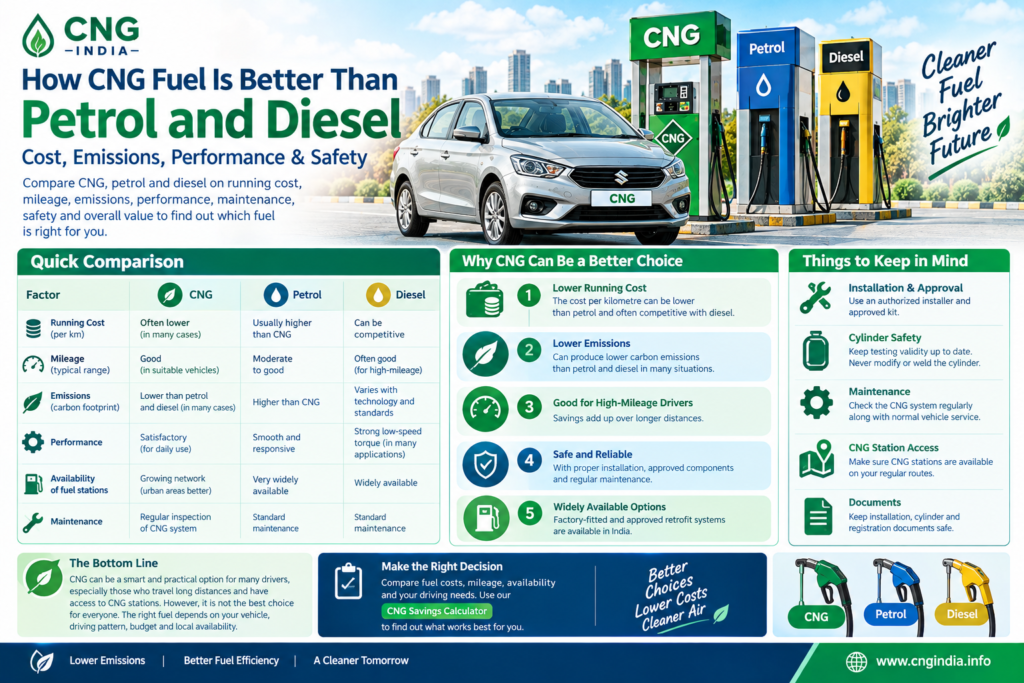
| Factor | CNG | Petrol | Diesel |
|---|---|---|---|
| Typical running-cost potential | Often favourable for high-mileage use | Usually higher than CNG per kilometre, depending on local prices and mileage | Can be competitive for high-mileage applications |
| Fuel type | Compressed gaseous fuel | Liquid fuel | Liquid fuel |
| Vehicle availability | Factory-fitted and approved retrofit options | Very widely available | Widely available, especially in commercial vehicles |
| Refuelling convenience | Depends on local CNG station network | Generally very convenient | Generally very convenient |
| Tailpipe emissions | Generally lower carbon emissions than conventional fuels | Higher carbon emissions than CNG for comparable use | Emission profile differs and depends strongly on vehicle technology and applicable standards |
| Performance characteristics | Can differ from petrol depending on vehicle and calibration | Generally smooth and responsive | Strong low-speed torque in many applications |
| Best suited to | Drivers seeking lower running costs where CNG is readily available | Drivers prioritising widespread refuelling convenience | Some high-mileage and load-carrying applications |
This table gives a general comparison. Actual mileage, cost and performance vary by vehicle model, engine, driving conditions, fuel prices and maintenance condition.
1. CNG Can Reduce Your Running Cost
For many CNG users, the biggest advantage is the potential reduction in fuel expenditure per kilometre.
The important number is not simply the price of one kilogram of CNG or one litre of petrol. What matters is the cost per kilometre.
You can calculate it using this simple formula:
Fuel cost per kilometre = Fuel price ÷ Vehicle mileage
For example, suppose a vehicle achieves:
- 15 km per litre on petrol
- 22 km per kg on CNG
If petrol costs ₹100 per litre and CNG costs ₹80 per kg, the approximate running cost would be:
- Petrol: ₹100 ÷ 15 = ₹6.67 per km
- CNG: ₹80 ÷ 22 = ₹3.64 per km
The difference would be approximately ₹3.03 per kilometre in this illustrative example only.
Actual savings will depend on your local fuel prices, real-world mileage, traffic, driving style and vehicle condition.
2. CNG Can Be Particularly Useful for High-Mileage Drivers
A person driving 500 km a month and someone driving 3,000 km a month have very different fuel requirements.
For high-mileage users, even a small saving per kilometre can accumulate over thousands of kilometres.
For example, if the difference between two fuels is ₹2 per kilometre:
- 1,000 km per month = ₹2,000 potential difference
- 2,000 km per month = ₹4,000 potential difference
- 3,000 km per month = ₹6,000 potential difference
These figures are only mathematical examples. They should not be treated as guaranteed savings because actual fuel costs and mileage vary.
You can use our CNG Savings Calculator to calculate your own estimated running-cost difference.
3. CNG Has Different Emission Characteristics
One important reason CNG is considered a cleaner automotive fuel is its chemical composition and combustion characteristics.
Compared with conventional petrol and diesel use, CNG vehicles can produce lower carbon emissions under comparable conditions. PNGRB also describes CNG as a more environmentally friendly fuel option with lower carbon emissions than traditional fuels.
However, it is important not to say that CNG vehicles produce “zero pollution” or are completely carbon-free.
CNG is not a carbon-free fuel. Natural gas is primarily methane, and methane contains carbon. A CNG engine still produces carbon dioxide during combustion.
Actual emissions depend on the engine, fuel system, vehicle technology, maintenance, driving conditions and applicable emission standards.
4. CNG Is Recognised Within India’s Vehicle Emission Framework
CNG is not an unregulated alternative fuel. Indian vehicle regulations include specific provisions for vehicles operating on compressed natural gas.
For example, Ministry of Road Transport and Highways regulations specify provisions for CNG vehicle emission requirements under the applicable Central Motor Vehicle Rules.
This is important for vehicle owners because a properly approved CNG system should not be confused with an improvised or unauthorised fuel conversion.
5. Factory-Fitted CNG vs Retrofit CNG
There are two common ways a vehicle may operate on CNG:
Factory-Fitted CNG
A factory-fitted CNG vehicle is designed and supplied by the vehicle manufacturer with the CNG system integrated into the vehicle.
The manufacturer designs the vehicle and fuel system to work together and provides the relevant vehicle documentation and service procedures.
Retrofit CNG
A petrol or eligible vehicle can also be converted to CNG using an approved retrofitment system where permitted.
ARAI states that in-use petrol and diesel vehicles can be converted to CNG subject to the applicable approval requirements, and that the kit manufacturer must obtain approval from a testing agency notified under Rule 126.
For this reason, vehicle owners should not choose a CNG kit solely on the basis of price. The compatibility, approval, installer qualification and documentation are important.
6. CNG Can Offer Good Mileage, But Mileage Is Not the Same as Savings
Many people search for the mileage of a CNG car before buying or converting a vehicle.
However, mileage figures should always be considered together with fuel price.
A vehicle may deliver a different number of kilometres per unit of CNG than it delivers per litre of petrol. Therefore, comparing mileage numbers alone can give a misleading impression.
The better comparison is:
Cost per kilometre = Fuel price ÷ Real-world mileage
Traffic, tyre pressure, air-conditioning use, passenger load, road conditions, driving style and vehicle maintenance can all affect real-world fuel economy.
7. What About CNG Vehicle Performance?
Performance is one area where the answer is not simply “CNG is better.”
The driving characteristics of a CNG vehicle depend on the engine, fuel system, calibration, vehicle design and whether the system is factory-fitted or retrofitted.
Some drivers may notice a difference in acceleration or power delivery when comparing petrol and CNG operation in the same vehicle.
This does not automatically mean that the CNG system is unsuitable. The system must be correctly matched, installed and calibrated for the vehicle.
For retrofit vehicles, installation by an authorised or properly qualified installer and use of an approved system are particularly important.
8. CNG vs Diesel: The Comparison Is More Complicated
It is common to compare CNG with petrol, but CNG vs diesel requires more consideration.
Diesel engines have traditionally been used extensively for vehicles that cover high annual distances or carry heavier loads. They can offer strong low-speed torque and may be suitable for certain commercial applications.
CNG can also be useful for commercial vehicles, particularly where suitable CNG infrastructure is available and the vehicle is designed or approved for CNG operation.
Therefore, a driver should consider the vehicle’s intended use rather than assuming that one fuel is automatically better for every application.
9. Maintenance of a CNG Vehicle
A common misconception is that a CNG vehicle requires no maintenance.
Like every other fuel-powered vehicle, a CNG vehicle requires regular inspection and maintenance.
Depending on the vehicle and system, attention may be required for:
- Engine oil and filters
- Air filter
- Spark plugs and ignition components
- CNG injectors
- Pressure regulator or reducer
- High-pressure lines and connections
- Electrical and electronic components
- CNG cylinder and valve
- Mounting hardware
- Leak inspection
PNGRB specifically advises CNG consumers to use a PESO-approved cylinder with valid testing and a CNG kit from an authorised dealer or retrofitter, and to have the cylinder hydro-tested through a PESO-authorised testing agency before its due date.
10. CNG Cylinder Safety Is Important
The CNG cylinder is one of the most important safety components of a CNG vehicle because it stores compressed gas at high pressure.
Vehicle owners should never attempt to modify, weld, repair or tamper with a CNG cylinder.
Keep the cylinder testing validity up to date and have inspections carried out through the appropriate authorised channels.
Do not assume that a CNG vehicle is safe simply because it has been running without problems for several years. Periodic inspection remains important.
11. Is CNG Safer Than Petrol and Diesel?
Fuel safety should not be reduced to a simple “safe” or “unsafe” comparison.
CNG systems contain high-pressure components and therefore require correct installation, inspection and maintenance.
PNGRB’s current consumer guidance requires the use of an approved CNG cylinder with valid testing and a CNG kit from an authorised dealer or retrofitter.
At a CNG station, consumers should follow the station’s safety instructions, including switching off the engine and following restrictions on activities such as smoking and mobile-phone use where applicable.
12. CNG Refuelling Infrastructure Matters
Fuel availability is one of the most important practical differences between CNG, petrol and diesel.
Petrol and diesel stations are widely available across India. CNG availability has expanded considerably, but the network is still more dependent on location and city.
Before purchasing a CNG vehicle or converting an existing vehicle, check the CNG stations available on your regular routes.
If you frequently travel to locations where CNG stations are unavailable, the convenience advantage of petrol or diesel may become more important to you.
13. CNG Can Be a Practical Choice for Daily City Driving
CNG is often considered by people who drive regularly within cities, especially when their daily routes have convenient access to CNG stations.
Taxi operators, fleet owners, delivery vehicles and private car owners with high annual mileage may particularly benefit from calculating the actual cost per kilometre before choosing a fuel.
The important point is to make the decision using your own driving pattern rather than relying only on advertised mileage or general claims.
14. When CNG May Not Be the Right Choice
CNG is not automatically the best option for every driver.
You may need to think carefully about CNG if:
- CNG stations are not conveniently available on your regular routes.
- Your monthly driving distance is very low.
- Your vehicle is not approved or suitable for the intended conversion.
- You are considering an unapproved or poorly documented retrofit kit.
- You regularly need maximum luggage space and the vehicle’s cylinder arrangement affects available space.
- You frequently travel to areas where CNG availability is limited.
15. How to Calculate Whether CNG Will Save You Money
Before changing fuels, calculate your expected running cost rather than relying on assumptions.
Use these steps:
- Record your average monthly kilometres.
- Find your actual petrol or diesel mileage.
- Find the current local fuel price.
- Calculate your current cost per kilometre.
- Estimate realistic CNG mileage for your vehicle.
- Check the current local CNG price.
- Calculate the estimated CNG cost per kilometre.
- Compare the difference over a month and a year.
- If converting an existing vehicle, include the complete conversion cost.
- Calculate the approximate payback period.
For a retrofit vehicle, also consider installation, documentation, maintenance and other ownership costs rather than looking only at fuel prices.
16. CNG Conversion Payback Period
If you are converting a petrol vehicle to CNG, the fuel saving needs to recover the conversion expense.
A simple calculation is:
Payback period = CNG conversion cost ÷ monthly fuel saving
For example, if the illustrative conversion cost is ₹50,000 and the estimated monthly fuel saving is ₹5,000:
₹50,000 ÷ ₹5,000 = 10 months
This is only an example. Your actual payback period may be shorter or longer depending on fuel prices, mileage, annual kilometres and installation costs.
17. CNG vs Petrol vs Diesel: Which Factors Should You Compare?
Instead of asking only “Which fuel is better?”, compare the following factors:
- Fuel price in your area
- Real-world mileage
- Cost per kilometre
- Monthly driving distance
- Annual driving distance
- Availability of fuel stations
- Vehicle purchase or conversion cost
- Maintenance requirements
- Vehicle performance
- Luggage-space requirements
- Safety and compliance requirements
- Expected ownership period
This approach gives a much more realistic picture of the total cost and practicality of each fuel.
18. Important Things to Check Before Installing a CNG Kit
If you are considering converting a petrol vehicle to CNG, do not choose a kit only because it is cheaper.
Check:
- Whether your vehicle and engine are compatible with the proposed system.
- Whether the CNG kit has the required approval.
- Whether the installer is authorised or appropriately qualified.
- Whether the cylinder has valid approval and testing.
- Whether the installation documentation is provided.
- Whether the system is correctly calibrated.
- Whether the vehicle’s registration and applicable documentation need updating.
- Whether after-sales service is available.
- Whether replacement components are available.
- Whether the installation complies with applicable regulations.
ARAI’s retrofitment guidance confirms that CNG conversion is subject to regulatory requirements relating to emissions, safety, installation and approval.
19. CNG Is Not Simply About Saving Money
Although running cost is one of the biggest reasons people choose CNG, the decision should also consider environmental and practical factors.
CNG can provide lower carbon emissions than conventional fuels, while also offering an alternative fuel option for suitable vehicles.
At the same time, CNG requires a suitable vehicle, properly installed equipment, regular maintenance and access to refuelling infrastructure.
Frequently Asked Questions About CNG vs Petrol and Diesel
Is CNG cheaper than petrol?
CNG can have a lower running cost per kilometre than petrol in many situations, but the actual difference depends on local fuel prices and real-world mileage.
Is CNG cheaper than diesel?
It can be in some applications, but the comparison depends on the vehicle, fuel prices, mileage, annual usage and maintenance costs. Diesel may remain suitable for certain high-load or long-distance applications.
Does CNG give better mileage than petrol?
CNG and petrol mileage should not be compared only by kilometres per unit because CNG is measured by mass while petrol is measured by volume. The more useful comparison is fuel cost per kilometre.
Does CNG reduce pollution?
CNG can produce lower carbon emissions than conventional petrol and diesel fuels under comparable conditions, but a CNG vehicle is not pollution-free or carbon-free.
Is a CNG car good for daily use?
A CNG vehicle can be practical for daily use when the vehicle is suitable, the system is properly maintained and convenient CNG refuelling is available on your regular routes.
Can an old petrol car be converted to CNG?
Some eligible petrol vehicles can be converted using an approved CNG retrofitment system. The vehicle, kit and installation must meet the applicable requirements. ARAI confirms that conversion of in-use petrol and diesel vehicles to CNG is permitted subject to the relevant approval requirements.
Is CNG maintenance-free?
No. CNG vehicles require regular maintenance and inspection just like other vehicles. The CNG fuel system, cylinder and associated components also need appropriate checks.
Is CNG completely safe?
No fuel system should be treated as risk-free. A properly approved and maintained CNG system, combined with correct refuelling and safety practices, is important for safe operation.
How can I calculate my CNG savings?
You can compare your current fuel cost per kilometre with the estimated CNG cost per kilometre and then calculate the difference over your monthly and yearly driving distance. Our CNG Savings Calculator can help with this calculation.
Final Thoughts
CNG can offer important advantages over petrol and diesel, particularly for drivers who cover a high number of kilometres and have convenient access to CNG refuelling stations. Potentially lower running costs and lower carbon emissions are among the main reasons CNG has become an important automotive fuel option.
However, there is no single fuel that is ideal for every vehicle and every driver. Petrol, diesel and CNG each have different characteristics related to cost, performance, availability, vehicle type and maintenance.
If you are considering CNG, start with your own numbers: monthly kilometres, real-world mileage, local fuel prices, CNG availability and total conversion or vehicle cost.
For retrofit vehicles, always give equal importance to approved equipment, proper installation, cylinder testing, documentation and maintenance.
For more information, explore our guides on What Is CNG?, Know Your CNG Kit, CNG Cylinders, CNG Car Owner Do’s and Don’ts and the CNG Savings Calculator.