Rising fuel expenses are one of the biggest concerns for people who drive their cars regularly. If you own a petrol vehicle and cover a significant number of kilometres every month, you may have considered installing a CNG kit to reduce your running expenses.
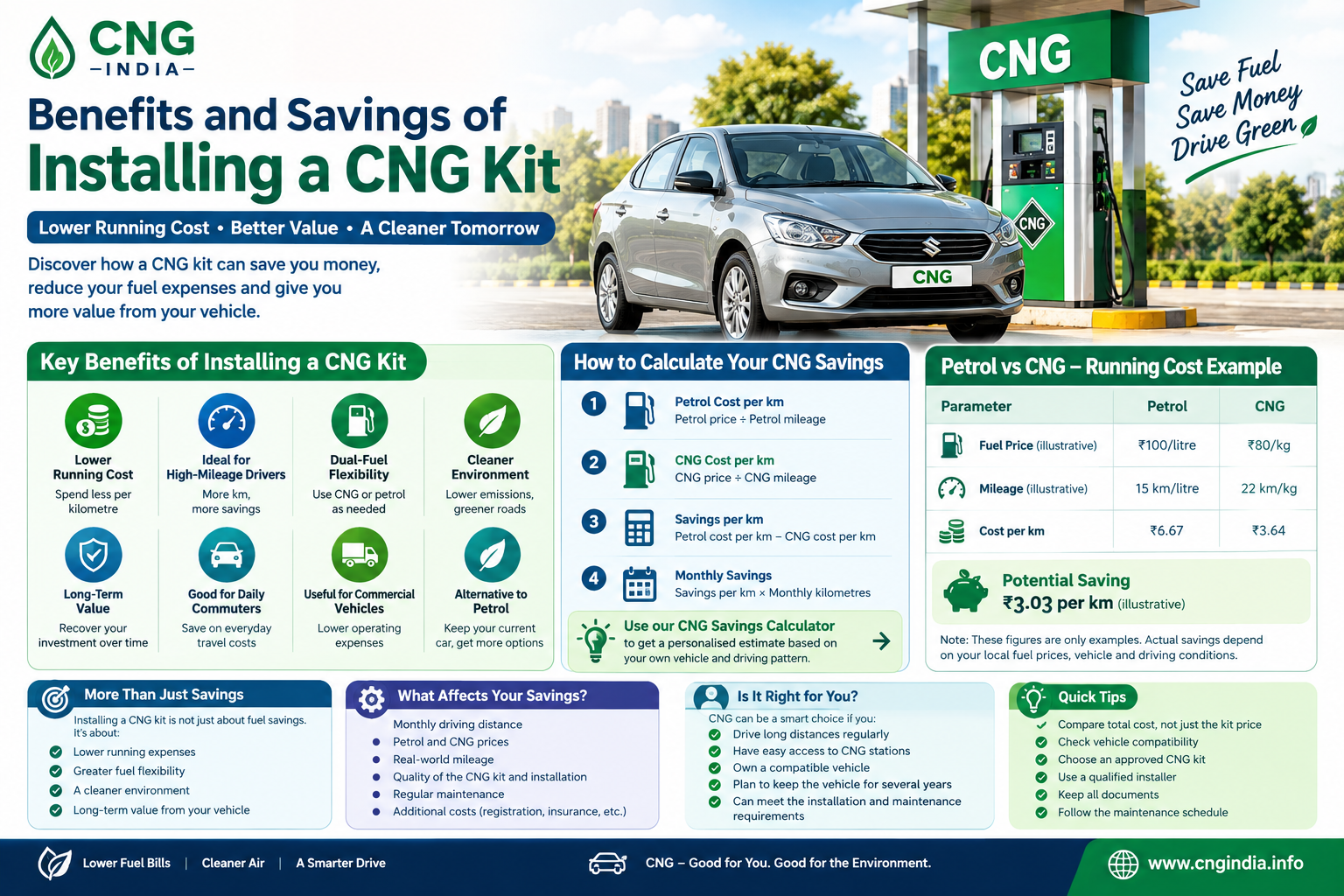
Compressed Natural Gas (CNG) can provide a lower running cost per kilometre than petrol in many situations. However, the actual savings depend on several factors, including your vehicle’s mileage, local petrol and CNG prices, monthly driving distance, CNG kit cost and installation expenses.
Installing a CNG kit is therefore not simply about paying for a kit and immediately expecting large savings. You should first understand the benefits, calculate your actual running cost and consider the complete cost of conversion.
In this guide, we explain the major benefits of installing a CNG kit, how to calculate your potential savings, how long it may take to recover the conversion cost and what you should check before converting your car.
Why Are Car Owners Switching to CNG?
CNG has become an important automotive fuel option in India, particularly for people who drive frequently and have convenient access to CNG stations.
For an eligible vehicle, a properly installed CNG retrofit system can allow the owner to use CNG as an alternative fuel while retaining petrol operation in many dual-fuel configurations.
The biggest reason many owners consider CNG is the potential reduction in fuel expenditure per kilometre.
However, the financial benefit is not the same for everyone. Someone driving 500 kilometres a month and someone driving 3,000 kilometres a month will have very different savings even if both vehicles achieve similar mileage.
Main Benefits of Installing a CNG Kit
1. Potentially Lower Running Cost
The primary reason for installing a CNG kit is the possibility of reducing fuel cost per kilometre.
If the cost of travelling one kilometre on CNG is lower than the cost of travelling the same kilometre on petrol, the difference can add up significantly over a year, especially for high-mileage drivers.
However, your actual saving should be calculated using your own vehicle’s real-world mileage and the current fuel prices in your area.
2. Useful for High-Mileage Drivers
CNG can be particularly interesting for people who drive their cars frequently.
For example, drivers who regularly travel long distances for work, business, commuting or commercial activities have more opportunities to recover the initial cost of conversion through fuel savings.
The more kilometres you drive, the more important the difference in fuel cost per kilometre becomes.
3. Dual-Fuel Flexibility
Many CNG vehicles use a dual-fuel configuration, allowing the vehicle to operate on CNG as well as petrol.
This can be useful when CNG is not available on a particular route. The exact operation and fuel-switching behaviour depend on the vehicle and CNG system, so always follow the manufacturer’s instructions.
4. Alternative to Petrol
For an eligible petrol vehicle, a suitable CNG retrofit system can provide another fuel option without requiring the owner to purchase a completely new vehicle.
This can be attractive for owners who are satisfied with their existing car and intend to keep it for several more years.
5. Potential Long-Term Fuel Savings
A CNG conversion involves an initial expense, but the owner may recover that investment over time through lower fuel expenditure.
The actual payback period depends mainly on:
- Total CNG conversion cost
- Monthly kilometres driven
- Petrol price
- CNG price
- Petrol mileage
- CNG mileage
- Maintenance and service costs
6. Useful for Frequent Commuters
If you use your car every day for commuting, even a relatively small saving per kilometre can become meaningful when multiplied by your monthly driving distance.
This is why calculating your annual fuel expenditure is more useful than looking only at the price difference between one litre of petrol and one kilogram of CNG.
7. Potential Environmental Benefits
CNG is a gaseous fuel and can produce different exhaust emissions compared with conventional petrol or diesel operation. The actual emissions benefit depends on the vehicle, engine, fuel system, operating conditions and applicable emission standards.
Therefore, it is better to consider CNG as an alternative fuel with potential emissions advantages rather than assuming that every CNG vehicle produces the same percentage reduction in every pollutant.
How Much Can You Save With CNG?
There is no single saving figure that applies to every CNG car.
Your savings depend on the difference between the cost of running your vehicle on petrol and the cost of running it on CNG.
For example, suppose an illustrative petrol car gives:
- Petrol mileage: 15 km/litre
- Petrol price: ₹100 per litre
The approximate petrol running cost would be:
₹100 ÷ 15 = ₹6.67 per kilometre
Now suppose the same vehicle, after a suitable CNG conversion, gives an illustrative CNG mileage of:
- CNG mileage: 22 km/kg
- CNG price: ₹80 per kg
The approximate CNG running cost would be:
₹80 ÷ 22 = ₹3.64 per kilometre
In this example, the estimated difference would be:
₹6.67 − ₹3.64 = ₹3.03 per kilometre
Important: These figures are only an example to explain the calculation. They are not a guarantee of actual mileage, fuel prices or savings. Your local fuel prices and your vehicle’s real-world mileage should be used for an accurate estimate.
How to Calculate Your CNG Savings
You can calculate your potential savings using four simple steps.
Step 1: Calculate Petrol Cost Per Kilometre
Petrol cost per km = Petrol price per litre ÷ Petrol mileage in km/litre
For example, if petrol costs ₹100 per litre and your car gives 15 km/litre:
₹100 ÷ 15 = ₹6.67 per km
Step 2: Calculate CNG Cost Per Kilometre
CNG cost per km = CNG price per kg ÷ CNG mileage in km/kg
If CNG costs ₹80 per kg and the vehicle gives 22 km/kg:
₹80 ÷ 22 = ₹3.64 per km
Step 3: Calculate Savings Per Kilometre
Savings per km = Petrol cost per km − CNG cost per km
Using the example above:
₹6.67 − ₹3.64 = ₹3.03 per km
Step 4: Calculate Monthly Savings
If you drive 2,000 km per month:
Monthly saving = ₹3.03 × 2,000
Estimated monthly saving = ₹6,060
Again, this is an illustration only. Actual savings will change when fuel prices, mileage or monthly driving distance changes.
How Long Does It Take to Recover the CNG Kit Cost?
The time required to recover the cost of a CNG conversion is commonly called the payback period.
You can estimate it using:
Payback period = Total conversion cost ÷ Monthly fuel savings
For example, if your complete conversion cost is ₹50,000 and your estimated monthly fuel saving is ₹6,060:
₹50,000 ÷ ₹6,060 ≈ 8.25 months
In this illustration, the theoretical payback period would be approximately eight to nine months.
But real-world payback can be longer because fuel prices change, mileage varies and the vehicle may have additional maintenance or documentation expenses.
For a more practical calculation, use our CNG Savings Calculator and enter your own fuel prices, mileage and monthly kilometres.
Factors That Affect Your Actual CNG Savings
Two people can install similar CNG systems and achieve very different savings. This happens because fuel economics depend on actual usage.
Monthly Driving Distance
This is one of the biggest factors.
If you drive only a few hundred kilometres each month, your annual fuel savings may be relatively small. If you drive several thousand kilometres every month, the same saving per kilometre can produce a much larger annual benefit.
Petrol Price
When petrol becomes more expensive, the difference between petrol and CNG running costs can change.
CNG Price
CNG prices vary by city and can change over time. Always use the current price applicable to your area when calculating your expected savings.
Actual Vehicle Mileage
Do not use only the mileage claimed in advertisements or laboratory testing.
Use a realistic figure based on your own driving conditions. Traffic, air conditioning, road conditions, vehicle load, driving style and vehicle maintenance can all affect fuel consumption.
CNG Kit and Installation Quality
The quality and suitability of the retrofit system and the quality of installation and calibration can affect vehicle operation and fuel economy.
For this reason, choosing a suitable approved retrofit system and an appropriate installer is more important than simply selecting the cheapest quotation.
Maintenance
A CNG vehicle still requires regular maintenance. Engine condition, ignition components, air filters, cooling systems and CNG components all need appropriate attention.
Neglecting maintenance can affect performance and fuel economy.
Does CNG Really Give Better Mileage?
It is important to understand the difference between mileage and running cost.
A vehicle may travel a different number of kilometres per unit of CNG compared with kilometres per litre of petrol. Therefore, comparing the numbers directly can be misleading.
For example, 15 km/litre on petrol and 22 km/kg on CNG cannot be compared simply by saying that 22 is greater than 15.
The correct comparison is the cost per kilometre.
This is why fuel price and mileage should always be considered together.
CNG Kit Installation Cost: What Are You Actually Paying For?
The cost of installing a CNG kit is not limited to the price of the kit itself.
The total conversion expense can depend on:
- Vehicle make and model
- Engine configuration
- Compatible retrofit kit
- CNG cylinder
- Regulator and other components
- Injectors and electronic control components
- Installation labour
- Calibration and testing
- Mounting arrangements
- Documentation
- Applicable registration-related requirements
- Applicable insurance-related requirements
Always ask for a complete quotation instead of comparing only the advertised price of a CNG kit.
Why Choosing the Right CNG Kit Matters
A CNG conversion is a fuel-system modification involving components that must be suitable for the vehicle and installed correctly.
ARAI states that retrofitment of eligible in-use petrol or diesel vehicles to CNG is subject to applicable requirements and that kit manufacturers must obtain approval from a notified Rule 126 testing agency.
This means you should not choose a CNG kit only because it is inexpensive or because someone has installed the same brand on another vehicle.
Before installation, ask the installer about:
- Kit manufacturer
- Kit model
- Vehicle compatibility
- Applicable type-approval information
- Installer authorization
- Warranty
- Service support
- Availability of replacement components
Importance of the CNG Cylinder
The CNG cylinder is a high-pressure storage component and should never be treated as an ordinary fuel tank.
The cylinder must be suitable for the vehicle application, properly installed and maintained according to applicable requirements.
PNGRB’s current consumer guidance states that CNG consumers should ensure installation of a PESO-approved CNG cylinder with testing validity and a CNG kit from an authorized dealer or retrofitter. It also requires hydro-testing through a PESO-authorized testing agency before the due date.
Never allow a CNG cylinder to be welded, drilled, cut or modified.
If you notice damage, corrosion, loose mounting or any unusual condition around the cylinder, have it inspected by an appropriate professional.
Read our detailed CNG Cylinders guide to learn more.
Benefits of CNG for High-Mileage Drivers
The financial case for CNG can be particularly important for people who drive a large number of kilometres.
Consider two drivers:
| Driver | Monthly Distance | Potential Impact of ₹3/km Saving |
|---|---|---|
| Driver A | 500 km | ₹1,500/month |
| Driver B | 1,500 km | ₹4,500/month |
| Driver C | 2,500 km | ₹7,500/month |
| Driver D | 4,000 km | ₹12,000/month |
The figures above are purely illustrative and assume a constant ₹3 per kilometre saving. Actual savings can be higher or lower.
This example demonstrates why the number of kilometres driven can have a major effect on the financial value of a CNG conversion.
Benefits of CNG for Commercial and Business Users
People who use vehicles for business, delivery, transportation or frequent travel may pay particularly close attention to fuel cost.
For a high-use vehicle, even a small reduction in fuel cost per kilometre can become significant over thousands of kilometres.
However, commercial vehicle owners should also consider downtime, maintenance, service availability, regulatory requirements and the suitability of the particular vehicle and retrofit system.
The calculation should therefore include the complete operating cost rather than fuel alone.
Annual CNG Savings Can Be More Important Than Monthly Savings
Many car owners look only at their monthly saving. A better approach is to calculate the potential annual difference.
For example, if your estimated saving is ₹4,000 per month:
Annual saving = ₹4,000 × 12 = ₹48,000
This does not mean you will definitely save ₹48,000 every year. Fuel prices, mileage, driving distance and maintenance costs can change.
Nevertheless, an annual calculation makes it easier to compare the potential savings with the initial conversion cost.
Don’t Forget the Additional Costs
When calculating the financial benefit of CNG, do not look only at fuel expenditure.
You should also consider:
- Initial CNG kit cost
- Cylinder cost
- Installation cost
- Calibration and testing
- Required documentation
- Registration-related expenses, where applicable
- Insurance-related changes, where applicable
- Periodic cylinder testing
- CNG system servicing
- Replacement of components when required
A realistic calculation should compare the total additional cost of conversion with the actual fuel savings over the period you expect to own the vehicle.
CNG Conversion: Financial Benefits vs Initial Investment
| Factor | Effect on Your Decision |
|---|---|
| High monthly driving | Can increase potential fuel savings |
| Low monthly driving | May make payback slower |
| High petrol price | Can increase the difference in running cost |
| Low CNG price | Can improve potential savings |
| Good real-world CNG mileage | Can reduce cost per kilometre |
| High conversion cost | Can increase payback period |
| Poor installation | Can affect reliability and economy |
| Limited CNG availability | Can reduce the practical convenience of CNG |
Is CNG Conversion Worth It for Every Car Owner?
No.
The financial benefit depends on your individual driving pattern.
CNG may be more financially attractive when:
- You drive many kilometres every month.
- CNG is easily available on your regular routes.
- Your vehicle is suitable for an approved retrofit system.
- You plan to keep the vehicle for several years.
- You choose a reliable installation facility.
- Your calculated fuel saving is sufficient to recover the conversion investment within your ownership period.
On the other hand, the financial benefit may be limited if you drive very little, have poor access to CNG stations or plan to sell the vehicle shortly after conversion.
Environmental Benefits of Using CNG
In addition to fuel economics, CNG is often considered because of its emissions characteristics compared with conventional liquid fuels.
Government information has described CNG as capable of reducing certain emissions compared with petrol or diesel operation, although the actual result depends on the vehicle, engine, technology and operating conditions.
For this reason, it is better to view environmental performance as one of the potential advantages of CNG rather than relying on a single universal percentage reduction.
Advantages of Installing a CNG Kit
- Potentially lower fuel cost per kilometre
- Can be useful for high-mileage drivers
- Can provide an alternative fuel for eligible vehicles
- Many systems retain petrol operation
- Can reduce annual fuel expenditure when the economics are favourable
- May make sense for long-term vehicle ownership
- CNG availability continues to expand in many parts of India
- Can provide potential environmental benefits compared with some conventional fuel use
Limitations of Installing a CNG Kit
- Initial conversion expense
- Additional components and cylinder weight
- Possible loss of luggage space depending on vehicle configuration
- Need for appropriate installation and calibration
- Regular CNG system inspection and maintenance
- Cylinder testing requirements
- CNG station availability may vary by location
- Additional documentation and regulatory requirements may apply
- Not every vehicle or configuration is necessarily suitable for retrofitment
10 Things to Check Before Installing a CNG Kit
- Check vehicle compatibility: Confirm that the particular vehicle and engine are suitable for the retrofit system.
- Verify the kit: Ask for the kit manufacturer, model and applicable approval information.
- Check the installer: Use an authorized or appropriately qualified installer for the applicable system.
- Check the cylinder: Confirm the cylinder details, installation and testing requirements.
- Ask for a complete quotation: Include the kit, cylinder, labour, installation and applicable additional charges.
- Ask about warranty: Understand what parts and services are covered.
- Check service availability: Make sure replacement parts and qualified service are available in your area.
- Understand documentation: Ask what installation, cylinder and registration-related documents you will receive.
- Calculate your savings: Use your real mileage, current fuel prices and monthly kilometres.
- Estimate the payback period: Compare the total conversion investment with your expected monthly and annual fuel savings.
Use a CNG Savings Calculator Before Making a Decision
One of the easiest ways to understand whether CNG conversion makes financial sense for you is to calculate your own running cost.
Our CNG Savings Calculator can help you compare petrol and CNG running costs based on mileage, fuel price and distance travelled.
Instead of using a general statement such as “CNG will save you 30%,” enter your own numbers.
You can compare:
- Petrol cost per kilometre
- CNG cost per kilometre
- Estimated saving per kilometre
- Monthly fuel expenditure
- Potential monthly saving
- Potential annual saving
- Estimated conversion payback period
This gives you a much more useful estimate based on your actual driving pattern.
Frequently Asked Questions About CNG Kit Benefits and Savings
What is the biggest benefit of installing a CNG kit?
For many users, the main potential benefit is lower fuel cost per kilometre compared with petrol. The actual saving depends on fuel prices, vehicle mileage and driving conditions.
How much money can I save with a CNG kit?
There is no fixed saving amount for every vehicle. Your saving depends on your petrol cost per kilometre, CNG cost per kilometre and the number of kilometres you drive.
Is CNG cheaper than petrol?
CNG can have a lower running cost per kilometre than petrol in many situations, but you should calculate the actual cost using current local fuel prices and your vehicle’s real-world mileage.
Does higher mileage make CNG more beneficial?
Higher monthly driving can increase the total amount of potential fuel savings because the saving per kilometre is multiplied over a larger distance.
How long does it take to recover the CNG kit cost?
The payback period depends on the complete conversion cost and your monthly fuel savings. Use the formula: conversion cost ÷ monthly fuel savings.
Is CNG conversion profitable for a low-mileage driver?
It may take longer for a low-mileage driver to recover the initial conversion cost because the vehicle accumulates fewer kilometres and therefore fewer fuel savings.
Does CNG always provide better mileage?
No universal mileage figure can be guaranteed. Actual CNG mileage depends on the vehicle, engine, kit, installation, calibration, traffic, driving style, load and maintenance.
Does installing a CNG kit reduce petrol usage?
If you use CNG for a significant portion of your driving, your petrol consumption can decrease. The actual amount depends on how often you operate the vehicle on CNG and the specific vehicle system.
Is an expensive CNG kit always better?
Price alone should not be used to judge a CNG kit. Vehicle compatibility, applicable approval, component quality, installation quality, calibration, warranty and service support are all important.
Can I install a CNG kit in any petrol car?
No. Retrofitment is subject to applicable requirements and the availability of a suitable approved system for the vehicle. Check your exact vehicle and engine with an appropriate installer before purchasing a kit.
Does a CNG kit require maintenance?
Yes. The vehicle and CNG system require appropriate periodic maintenance and inspection. Cylinder testing and inspection requirements must also be followed.
Is CNG safe after conversion?
A properly installed and maintained system can be used safely. Use appropriate components, a suitable cylinder, qualified installation and regular inspection, and never ignore suspected leaks or damage.
Related CNG Guides on CNGIndia.info
If you are researching CNG conversion, the following guides can help you understand the complete process:
- What Is CNG? A Complete Guide to CNG for Automobiles
- Switching to CNG? Here’s What You Need to Know Before Converting Your Car
- CNG Kits
- CNG Cylinders
- CNG Components
- CNG Fitment Center
- CNG Hydro Testing
- CNG Kit Service
- CNG Service Center
- CNG Car Owner Do’s and Don’ts
- How to Take Care of Your CNG Car at Home
- CNG Savings Calculator
Final Thoughts
Installing a CNG kit can potentially reduce the running cost of an eligible petrol vehicle, but the financial benefit depends on your individual driving pattern.
The most important number is not the price of CNG alone. You should compare the actual cost per kilometre of petrol and CNG, calculate your monthly and annual driving distance and then compare the expected fuel savings with the complete cost of conversion.
For a driver who covers many kilometres every month, even a modest saving per kilometre can become significant over time. For a low-mileage driver, the initial conversion investment may take much longer to recover.
Before installing a CNG kit, check vehicle compatibility, choose an appropriate approved retrofit system, use a suitable cylinder and select a reliable installation facility. Keep all documentation and follow the required maintenance and cylinder-testing schedule.
Most importantly, make the decision using your own numbers rather than relying on a generic mileage or savings claim.
Start by calculating your actual petrol and CNG running costs with our CNG Savings Calculator, and then decide whether CNG conversion makes financial sense for your vehicle and driving needs.





1 thought on “Benefits and Savings of Installing a CNG Kit: Complete Guide for Car Owners”