If you own a CNG car or are planning to convert your petrol vehicle to CNG, understanding the CNG kit is important. A CNG kit is not just a cylinder fitted inside the car. It is a complete fuel system made up of several components that store, regulate, control and deliver compressed natural gas to the engine.
Each component has a specific function, and the overall system needs to be compatible with the vehicle and installed correctly. The quality of the kit, installation and calibration can affect the vehicle’s performance, reliability, fuel economy and safety.
In this guide, we explain what a CNG kit is, how it works, the major CNG kit components, different types of systems, what you should check before installation and how to take care of the system after conversion.
What Is a CNG Kit?
A CNG kit is a collection of components that allows a suitable vehicle to use Compressed Natural Gas as a fuel.
In a typical retrofit installation, CNG is stored in a high-pressure cylinder and then passed through valves, high-pressure lines and a pressure regulator. The gas is reduced to the required pressure and supplied to the engine through the fuel-delivery system.
Electronic control components determine how much CNG should be supplied to the engine according to the vehicle’s operating conditions.
In many applications, the original petrol fuel system remains in place, allowing the vehicle to operate using either petrol or CNG, depending on the vehicle and system configuration.
A CNG kit should therefore be considered a complete engineered fuel system rather than a single product.
How Does a CNG Kit Work?
The basic operation of a CNG system can be understood in a few stages.
- CNG is filled into the vehicle’s high-pressure cylinder through the filling system.
- The cylinder stores the CNG at high pressure.
- A cylinder valve and associated safety components control the gas leaving the cylinder.
- High-pressure lines carry CNG toward the pressure-reduction system.
- The regulator or pressure reducer lowers the gas pressure to the level required by the fuel system.
- The electronic control system determines the required quantity of CNG.
- CNG injectors or the applicable fuel-delivery system supply the gas to the engine.
- The engine burns the air-fuel mixture to produce power.
The exact arrangement varies according to the vehicle, engine, CNG kit and system design.
Main Components of a CNG Kit
A CNG system can contain several components. The exact configuration depends on the vehicle and the type of retrofit system.
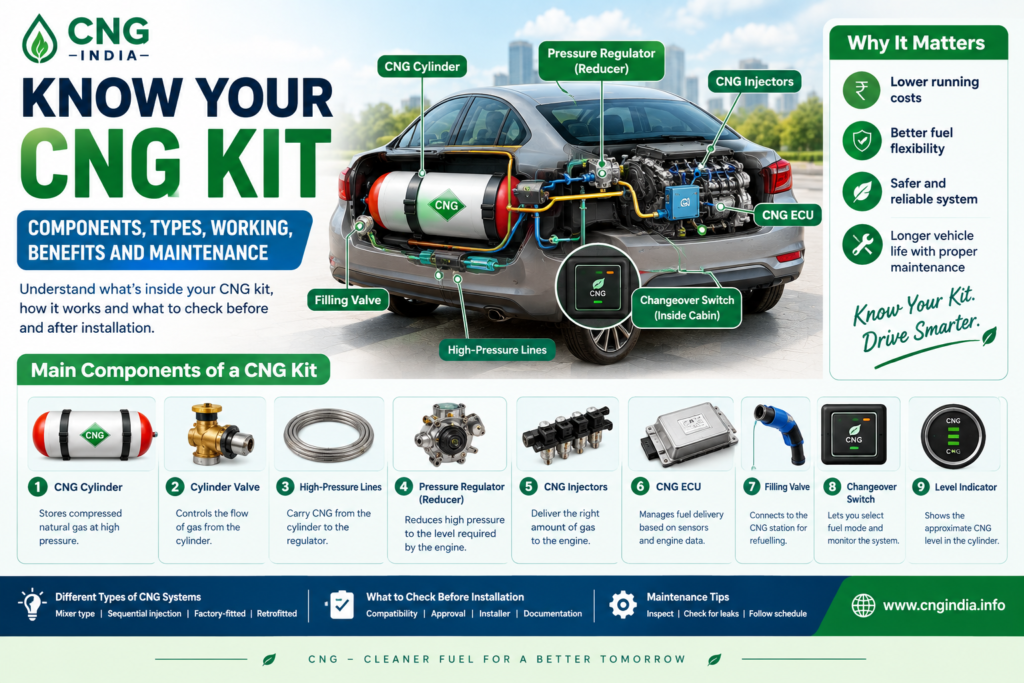
1. CNG Cylinder
The CNG cylinder is the high-pressure storage container that holds compressed natural gas in the vehicle.
Unlike a conventional petrol fuel tank, a CNG cylinder is designed for high-pressure gas storage and must meet the applicable safety and approval requirements.
The cylinder must be installed securely in the approved location and protected from damage. It should never be drilled, welded, cut or otherwise modified.
The cylinder also has testing requirements. PNGRB’s current consumer guidance says consumers should ensure a PESO-approved CNG cylinder with valid testing and should have the cylinder hydro-tested before its due date through a PESO-authorized testing agency.
Learn more in our complete CNG Cylinder guide.
2. Cylinder Valve
The cylinder valve is fitted to the cylinder and controls the flow of CNG from the storage vessel.
Depending on the system design, the valve assembly can incorporate safety-related functions and connections required for the CNG system.
Because the cylinder and valve operate with high-pressure gas, they should only be inspected or serviced by an appropriate professional.
3. High-Pressure CNG Lines
High-pressure lines carry CNG from the cylinder toward the pressure regulator or other parts of the fuel system.
These lines must be correctly routed, securely connected and protected against damage, excessive heat and other conditions specified by the installation requirements.
A suspected leak, damaged pipe or loose connection should never be ignored.
4. Pressure Regulator or Reducer
CNG is stored in the cylinder at high pressure, but the engine’s fuel system does not use the storage pressure directly.
The pressure regulator, commonly called a reducer in CNG systems, reduces the pressure of CNG to the level required by the fuel-delivery system.
The regulator is therefore an important part of the system and must be suitable for the particular CNG kit and vehicle application.
5. CNG Injectors
CNG injectors control the delivery of gas to the engine in systems that use electronic gas injection.
The amount of fuel delivered needs to be controlled according to engine operating conditions.
Dirty, damaged or incorrectly calibrated injectors can affect engine operation and fuel economy.
6. CNG ECU or Electronic Control Unit
The CNG ECU is the electronic control unit used by many modern CNG systems to manage fuel delivery.
It receives information from relevant sensors and controls the CNG fuel system according to the system’s calibration.
Proper calibration is important because the engine needs an appropriate air-fuel mixture under different operating conditions.
7. CNG Filling Valve
The filling valve is the connection point used to fill the vehicle with CNG at a compatible CNG station.
Its location varies by vehicle and installation design.
The filling connection should be kept clean and protected from damage. Any abnormality around the filling connection should be checked by an appropriate professional.
8. CNG Pressure Sensor
Many electronic CNG systems use pressure sensors to monitor the pressure in parts of the fuel system.
The information can be used by the control system to manage fuel delivery and system operation.
Sensor problems can result in incorrect readings or improper system operation and should be diagnosed using suitable equipment.
9. CNG Changeover Switch
The changeover switch is normally located inside the passenger compartment.
Depending on the system, it may allow the driver to select petrol or CNG operation and may display information such as the selected fuel mode or approximate CNG level.
The exact functions depend on the particular CNG kit.
10. CNG Level Indicator
A CNG system may use a pressure-based or electronic indication system to provide an estimate of the gas remaining in the cylinder.
The displayed level should be treated as an indication rather than an exact measurement of the amount of CNG remaining.
11. Safety Devices
CNG systems include safety-related components designed to help manage abnormal conditions.
The exact safety devices depend on the system and cylinder configuration.
Do not remove, bypass or modify safety devices. Any suspected problem should be inspected by an appropriately qualified professional.
12. Mounting Brackets and Hardware
The cylinder and other components must be securely mounted to the vehicle using appropriate hardware and installation methods.
Proper mounting is particularly important because the cylinder is a heavy high-pressure component and must remain securely positioned during normal vehicle operation.
How Are the CNG Kit Components Connected?
A simplified CNG fuel path can be understood as:
CNG filling point → Cylinder → Cylinder valve → High-pressure line → Regulator/Reducer → CNG injectors → Engine
The electronic control system works alongside these components to control fuel delivery.
This is a simplified explanation. Actual systems can contain additional components, sensors, valves and connections depending on the vehicle and kit design.
Types of CNG Kits
CNG systems have evolved over time, and different types of systems have been used depending on the vehicle and engine technology.
Venturi or Mixer-Type CNG Systems
Older CNG systems may use a mixer-based approach in which CNG is introduced into the engine’s intake system.
These systems are generally associated with older vehicle and engine technologies.
The suitability of any particular system depends on the vehicle and applicable approval requirements.
Sequential CNG Injection Systems
Modern electronically controlled CNG systems can use sequential gas injection, where CNG is delivered through dedicated injectors under electronic control.
The system can use information from the vehicle and CNG-system sensors to manage fuel delivery.
For modern fuel-injected vehicles, the appropriate system should be selected specifically for the vehicle rather than assuming that any CNG kit will work equally well.
Factory-Fitted CNG System
A factory-fitted CNG vehicle is designed and integrated by the vehicle manufacturer as part of the vehicle’s approved configuration.
The CNG system, engine calibration and vehicle integration are developed as part of the manufacturer’s vehicle design.
Retrofitted CNG System
A retrofit CNG system is installed on an existing eligible vehicle.
ARAI states that conversion of in-use petrol or diesel vehicles to CNG is permissible subject to applicable requirements, and that CNG kit manufacturers must seek approval from a testing agency notified under Rule 126. Approval involves applicable component, engine and vehicle tests and other requirements.
ARAI’s applicable retrofitment requirements also specify that the installer should be authorized by the vehicle or kit manufacturer/supplier to fit the kit.
Why Is CNG Kit Calibration Important?
Installing the components is only one part of a CNG conversion. The system also needs to operate correctly with the engine.
Calibration determines how the CNG system responds to engine operating conditions and how much fuel is supplied under different circumstances.
Poor calibration can contribute to problems such as:
- Uneven engine operation
- Poor drivability
- Reduced fuel economy
- Difficulty during acceleration
- Engine warning lights
- Incorrect fuel delivery
Calibration should therefore be carried out using appropriate equipment and procedures for the specific CNG system and vehicle.
Does Every CNG Kit Fit Every Car?
No.
This is one of the most important things to understand before buying a CNG kit.
Different vehicles can have different:
- Engine designs
- Engine capacities
- Fuel-injection systems
- Electronic control systems
- Emission-control systems
- Available installation space
- Manufacturer requirements
Therefore, a CNG kit should be selected based on the particular vehicle and applicable approved application.
Never choose a kit only because it worked on a friend’s car or because it is available at a lower price.
What Makes a Good CNG Kit?
Instead of judging a CNG kit only by its brand name or price, consider the complete system.
Important factors include:
- Compatibility with your vehicle
- Applicable type approval
- Quality and suitability of components
- Authorized or qualified installation
- Proper calibration
- Availability of replacement components
- Warranty and after-sales support
- Availability of trained service technicians
- Proper documentation
ARAI’s retrofitment framework specifically addresses type approval and authorized installation for CNG retrofit systems.
What Should You Check Before Installing a CNG Kit?
Before paying for a CNG conversion, ask the installer several important questions.
- Is this kit suitable for my exact vehicle and engine?
- What is the kit manufacturer’s name and model?
- What approval or certification applies to this kit?
- Is this installation facility authorized for the applicable kit?
- What cylinder will be installed?
- What cylinder documentation will I receive?
- What is included in the installation price?
- What warranty is provided?
- Where can I get the kit serviced?
- What documents will be supplied after installation?
Getting these answers before installation can help you avoid problems later.
CNG Kit and CNG Cylinder Are Not the Same Thing
This is a common misunderstanding among new CNG users.
The CNG kit is the complete collection of components that allows the vehicle’s engine to use CNG.
The CNG cylinder is the high-pressure storage vessel that stores the gas.
The cylinder is an important part of the overall CNG system, but it should not be confused with the entire CNG kit.
A typical system can include the cylinder plus the valve, high-pressure lines, regulator, injectors, ECU, sensors, filling system, changeover switch and other components.
Why CNG Cylinder Testing Is Important
The cylinder is a high-pressure component and has specific testing requirements.
PNGRB’s current consumer guidance says that consumers should ensure a PESO-approved CNG cylinder with valid testing and should have the cylinder hydro-tested before its due date through a PESO-authorized testing agency.
PESO also currently publishes an approved list of CNG cylinder testing stations.
PESO published a circular on 8 July 2026 concerning verification of the validity of CNG cylinder test certificates before CNG filling.
This is why vehicle owners should keep track of their cylinder testing validity and not wait until a problem occurs.
Read our CNG Hydro Testing guide for more information.
What Should You Never Do With a CNG Kit?
CNG systems should not be treated like ordinary accessories that can be modified without considering safety and compatibility.
Never:
- Modify the cylinder.
- Weld or drill the cylinder.
- Bypass safety components.
- Use damaged high-pressure lines.
- Ignore a suspected CNG leak.
- Install random replacement components without checking compatibility.
- Attempt high-pressure CNG repairs yourself.
- Allow an unauthorized person to modify the system.
- Ignore unusual hissing sounds or gas smell.
- Continue using a system that has suffered significant accident damage without inspection.
Signs That Your CNG System May Need Inspection
Some changes in vehicle behaviour should not be ignored.
Consider having the system inspected if you notice:
- Unusual gas smell
- Hissing or unusual sounds
- Sudden change in CNG mileage
- Rough engine operation
- Difficulty switching fuel modes
- Repeated engine warning lights
- Unusual loss of power
- Visible damage to CNG components
- Loose or damaged cylinder mounting
- Problems after an accident
Not every symptom is necessarily caused by the CNG system, but unusual behaviour should be diagnosed rather than ignored.
How to Maintain Your CNG Kit
Proper maintenance can help keep the CNG system reliable and safe.
Follow the Recommended Service Schedule
Follow the vehicle and CNG system manufacturer’s maintenance recommendations.
Inspect the CNG System
Have the CNG components inspected periodically by an appropriate service professional.
Check for Leaks
Any suspected gas leak should be investigated promptly.
Maintain the Engine
CNG operation does not eliminate normal engine maintenance. Engine oil, spark plugs, air filters, coolant, battery and other vehicle components still require attention.
Monitor Cylinder Testing
Keep a record of the cylinder’s testing status and arrange required testing before the applicable due date.
Keep Your Documents Safe
Keep the CNG kit invoice, installation documents, cylinder documents, warranty information and other relevant records safely.
How Does a CNG Kit Affect Vehicle Performance?
Vehicle performance after CNG conversion depends on several factors, including the vehicle, engine condition, CNG system, installation quality and calibration.
A properly matched and calibrated system can provide normal day-to-day operation, but drivers may notice differences in acceleration or response compared with petrol operation.
Do not judge the quality of a CNG kit solely from one short test drive. Proper installation, calibration and maintenance all matter.
Does a CNG Kit Improve Fuel Economy?
A CNG system can reduce fuel expenditure when the cost per kilometre on CNG is lower than on petrol, but fuel economy depends on the vehicle and system.
Actual CNG mileage can be affected by:
- Vehicle model
- Engine condition
- CNG kit type
- Installation quality
- Calibration
- Driving style
- Traffic
- Air-conditioning use
- Vehicle load
- Tyre pressure
- Road conditions
- Maintenance
For this reason, avoid believing a universal mileage figure for every CNG vehicle.
CNG Kit vs Factory-Fitted CNG System
| Feature | Factory-Fitted CNG | Retrofitted CNG Kit |
|---|---|---|
| Installation | Integrated during vehicle manufacturing | Installed on an existing eligible vehicle |
| Vehicle integration | Designed as part of the manufacturer’s vehicle configuration | Depends on the approved retrofit system and installation |
| Kit selection | Specified by the vehicle manufacturer | Selected according to vehicle compatibility and applicable approval |
| Installation responsibility | Manufacturer production process | Authorized or appropriately qualified retrofit installer |
| Documentation | Part of the vehicle’s original documentation | Additional retrofit-related documentation may apply |
How Much Does a CNG Kit Cost?
There is no single CNG kit price that applies to every vehicle.
The complete conversion cost can depend on:
- Vehicle make and model
- Engine type
- CNG kit
- Cylinder size and type
- Installation requirements
- Additional components
- Calibration
- Documentation
- Applicable registration requirements
Instead of comparing only the kit price, compare the complete installation package and the quality of the components and service support.
For more information about the financial side of conversion, read our guide to CNG Kit Benefits and Savings.
Does a CNG Kit Require More Maintenance?
Installing a CNG system adds additional fuel-system components that require appropriate inspection and maintenance.
However, the vehicle still needs all of its normal maintenance, including:
- Engine oil replacement
- Air filter inspection
- Spark plug maintenance
- Cooling system checks
- Battery maintenance
- Brake inspection
- Tyre maintenance
- Suspension inspection
In addition, the CNG system should be checked according to the manufacturer’s recommendations.
Read our guide on how to take care of your CNG car at home for practical maintenance tips.
Is a CNG Kit Safe?
A properly designed, approved and correctly installed CNG system can be operated safely when the applicable safety and maintenance requirements are followed.
Safety depends on several factors:
- Suitable CNG kit
- Appropriate cylinder
- Correct installation
- Proper mounting
- Correct calibration
- Regular inspection
- Valid cylinder testing
- Proper maintenance
- Responsible vehicle operation
The biggest mistake is treating the CNG system as something that can be modified or repaired casually.
For more information, read our CNG Car Owner Do’s and Don’ts guide.
What Documents Should You Keep After CNG Installation?
After a retrofit installation, keep all documents supplied by the installer and relevant authorities.
These may include:
- Installation invoice
- Kit details
- Applicable type-approval information
- Installer authorization details
- Cylinder documentation
- Cylinder testing certificate
- Warranty documents
- Applicable registration documents
- Insurance-related documentation
- Service records
The exact documents and registration procedure can vary depending on the vehicle and state requirements.
How to Choose a CNG Kit Installer
The installer is almost as important as the kit itself.
Before choosing an installation centre, consider:
- Whether the installer is authorized for the applicable kit
- Experience with your vehicle type
- Quality of installation equipment
- Availability of proper calibration equipment
- Service and maintenance support
- Availability of genuine replacement components
- Warranty support
- Documentation provided after installation
Do not select an installer solely because the quotation is the cheapest.
10 Things Every CNG Car Owner Should Know About the CNG Kit
- A CNG kit is a complete fuel system, not just a cylinder.
- The cylinder is a high-pressure storage component and requires proper testing.
- Not every CNG kit is suitable for every vehicle.
- Applicable type approval is important for retrofitment.
- Installation should be performed by an appropriately authorized installer.
- Correct calibration affects vehicle operation.
- CNG system components require periodic inspection and maintenance.
- A suspected gas leak should never be ignored.
- Cylinder modification such as welding or drilling should never be attempted.
- Keeping your CNG documents and testing records updated is part of responsible ownership.
Frequently Asked Questions About CNG Kits
What is a CNG kit?
A CNG kit is a collection of components that allows a suitable vehicle to operate using compressed natural gas. It can include a cylinder, valves, high-pressure lines, regulator, injectors, electronic controls, sensors, filling system and other components.
Is the CNG cylinder part of the CNG kit?
The cylinder is an essential part of the overall CNG fuel system, but it is specifically the high-pressure storage vessel. The complete CNG system contains many additional components.
Can I install any CNG kit in my car?
No. The CNG system must be suitable for the particular vehicle and engine and comply with the applicable retrofitment and approval requirements.
What is the most important component of a CNG kit?
There is no single component that should be considered the only important part. The cylinder, valves, lines, regulator, injectors, electronic controls, mounting and other components all have specific functions and need to work together correctly.
How often should a CNG kit be serviced?
Follow the maintenance recommendations of the vehicle and CNG system manufacturer. The CNG system should also be inspected when there are signs of a problem or after an event such as an accident.
How long does a CNG kit last?
There is no single lifespan that applies to every CNG system component. Different components have different service requirements. The cylinder is subject to specific testing requirements, and components should be replaced when required.
Can I repair my CNG kit myself?
High-pressure CNG components should not be repaired or modified as a DIY project. Use an appropriate professional or authorized service facility.
Why is my CNG mileage lower than expected?
Fuel economy can be affected by vehicle condition, CNG kit type, calibration, traffic, driving style, air-conditioning use, tyre pressure, load and other factors. The system should be inspected if the change is sudden or significant.
Why does my car switch between petrol and CNG?
Dual-fuel systems can use petrol and CNG according to the vehicle’s operating strategy and system configuration. Automatic switching behaviour varies by vehicle and CNG system.
What should I do if I smell CNG?
Treat an unusual gas smell seriously. Avoid flames and other ignition sources, move to a safe location when possible and have the vehicle inspected by an appropriate professional. Do not attempt to repair a high-pressure leak yourself.
Related CNG Guides
- What Is CNG? A Complete Guide to CNG for Automobiles
- Switching to CNG? Here’s What You Need to Know Before Converting Your Car
- Benefits and Savings of Installing a CNG Kit
- CNG Cylinders
- CNG Components
- CNG Fitment Center
- CNG Hydro Testing
- CNG Kit Service
- CNG Service Center
- CNG Car Owner Do’s and Don’ts
- How to Take Care of Your CNG Car at Home
Final Thoughts
Knowing your CNG kit is useful whether you already own a CNG car or are planning to convert your petrol vehicle.
A CNG system is made up of several components that work together to store, regulate, control and deliver compressed natural gas to the engine. The cylinder, valves, high-pressure lines, regulator, injectors, electronic controls and other components all have important functions.
The most important thing for a vehicle owner is not to become a CNG technician, but to understand what is installed in the vehicle and recognize the importance of proper installation, maintenance and testing.
Always choose a suitable system for your vehicle, use an appropriately authorized installer, keep your documents and cylinder testing records safe, and never modify or repair high-pressure components yourself.
If you are planning to install a CNG kit, first read our complete guide to switching to CNG and then compare the potential financial benefits using our CNG Savings Calculator.




2 thoughts on “Know Your CNG Kit: Components, Working, Types, Benefits and Maintenance”