Owning a CNG car can be a practical way to reduce fuel expenses, especially for drivers who travel many kilometres regularly. However, a CNG vehicle has a fuel system that involves compressed natural gas, a high-pressure cylinder and specialized components. Proper use, regular maintenance and safe refuelling are therefore important.
Whether you have a factory-fitted CNG car or a properly approved retrofit system, following some basic CNG car do’s and don’ts can help you operate the vehicle safely and maintain its performance.
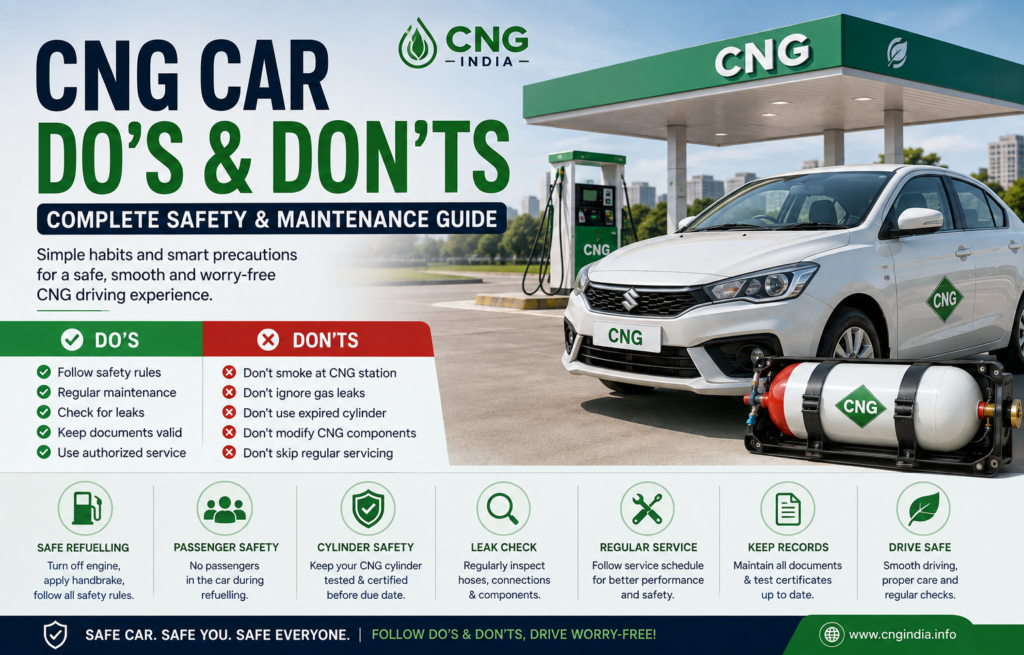
In this guide, CNGIndia explains the most important CNG safety tips, maintenance practices, refuelling precautions, cylinder-testing requirements and things CNG car owners should avoid.
Important: Always follow your vehicle manufacturer’s instructions and applicable safety requirements. For CNG-system work, use an appropriate authorized/qualified service provider.
CNG Car Do’s
Let’s begin with the things every CNG car owner should make a regular part of their routine.
1. Do Follow the Manufacturer’s CNG Instructions
Every CNG vehicle and CNG system may have specific operating and maintenance requirements.
Read the vehicle owner’s manual and follow the manufacturer’s instructions regarding:
- Starting the vehicle
- Switching between petrol and CNG
- Servicing
- Engine oil
- Spark plugs
- CNG-system inspection
- Cylinder information
- Warning indicators
Do not assume that every CNG vehicle operates in exactly the same way.
2. Do Turn Off the Engine While Refuelling
Always switch off the vehicle’s engine before CNG refuelling.
At a CNG station, follow the instructions provided by the station operator and observe all safety signs.
PNGRB consumer guidance specifically advises that the vehicle ignition should be switched off and the handbrake applied during CNG refuelling.
3. Do Leave Passengers Outside the Vehicle During Refuelling
Passengers should leave the vehicle before CNG refuelling and remain in the designated safe area of the station.
Current PNGRB consumer guidance says passengers should alight at the station entry and that no one should remain inside the vehicle during refuelling.
This is a simple precaution that should always be followed.
4. Do Apply the Handbrake
Before refuelling:
- Stop the vehicle in the designated position.
- Switch off the engine.
- Apply the handbrake firmly.
- Follow the CNG station operator’s instructions.
For automatic vehicles, follow the manufacturer’s recommended parking procedure as well.
PNGRB refuelling safety guidance includes applying the handbrake and keeping the vehicle stationary during refuelling.
5. Do Follow No-Smoking and No-Open-Flame Rules
CNG is a flammable fuel.
Never smoke or use an open flame around a CNG refuelling area.
Do not bring activities or materials that could create an ignition source near the CNG filling point.
PNGRB guidance specifies restrictions on smoking, naked flames and other ignition sources around the refuelling point.
6. Do Follow Mobile-Phone Restrictions at CNG Stations
Follow the CNG station’s safety instructions regarding mobile phones and electronic devices.
PNGRB’s current consumer guidance specifically states that mobile phones or RFID devices should not be used during the refuelling process.
When in doubt, follow the instructions displayed at the station.
7. Do Check for Signs of a CNG Leak
A CNG vehicle owner should pay attention to anything unusual, such as:
- An unusual gas smell
- Hissing or unusual sounds
- Damaged CNG pipes or connections
- Warning indicators
- Unusual engine behaviour
- Visible damage to CNG components
If you suspect a leak, do not attempt an unfamiliar repair yourself.
Move away from possible ignition sources and contact an appropriate qualified/authorized CNG service provider.
PNGRB advises CNG consumers to have the CNG kit and cylinder inspected for leakage through an authorized OEM/retrofitter.
8. Do Maintain the CNG System Regularly
A CNG vehicle still requires regular maintenance.
Depending on the vehicle and system, maintenance may include inspection of:
- CNG injectors
- Pressure regulator
- Fuel lines
- Connections
- Valves
- Cylinder
- Spark plugs
- Air filter
- Engine oil
- Ignition system
- Other vehicle components
Follow the maintenance schedule recommended for your particular vehicle and CNG system.
9. Do Use the Recommended Engine Oil
Use the engine oil specified by the vehicle manufacturer.
Do not choose engine oil simply because it is advertised as being suitable for CNG.
The correct oil depends on the engine and manufacturer’s specifications.
10. Do Keep Your CNG Cylinder Test Valid
The CNG cylinder is a high-pressure component and must be maintained and tested according to applicable requirements.
PNGRB’s current consumer guidance says CNG vehicles should have an approved CNG cylinder with valid testing and that owners should complete hydro-testing before the due date.
PNGRB safety audit documentation also references periodic hydraulic testing of vehicle CNG cylinders, including a three-year interval in the applicable checklist.
Do not wait until the last moment. Check the test information on your cylinder/documentation and arrange testing through an appropriate authorized testing facility before it becomes due.
11. Do Keep Records of CNG-System Testing
Keep the relevant documents and records associated with your CNG system and cylinder.
These may include:
- Cylinder test information
- CNG kit documentation
- Service records
- Inspection records
- Other applicable vehicle documents
PNGRB’s safety checklist specifically refers to carrying records showing the examination of vital CNG-system components and their next due dates.
12. Do Use an Authorized/Qualified CNG Service Provider
CNG-system components should not be treated like ordinary aftermarket accessories.
For CNG-system inspection, repairs, conversion or other specialized work, use an appropriate authorized/qualified workshop or retrofitter.
PNGRB consumer guidance specifically refers to an authorized dealer/retrofitter for CNG kit and cylinder-related requirements.
13. Do Keep the CNG Cylinder and Components Free From Obvious Damage
During normal vehicle checks, look for obvious signs of:
- Physical damage
- Corrosion
- Loose components
- Damaged pipes
- Damaged fittings
- Unusual marks
- Other visible abnormalities
Do not dismantle or repair high-pressure components yourself.
If something looks unusual, have it inspected by an appropriate professional.
14. Do Check the CNG System After Any Accident
Even if the vehicle appears to be running normally after an accident, damage to the CNG cylinder, valves, mounting system, pipes or other components may not always be obvious.
If your CNG vehicle has been involved in a significant collision, have the CNG system inspected by an appropriate qualified/authorized professional before continuing normal use.
15. Do Park the Vehicle Safely
Where practical, park the vehicle in a suitable, well-ventilated area.
Never store flammable or explosive materials inside or near a parked CNG vehicle.
PNGRB’s current CNG consumer guidance specifically advises against storing flammable or explosive goods inside or near parked vehicles.
CNG Car Don’ts
Knowing what not to do is just as important as knowing what to do.
1. Don’t Smoke While Refuelling
Never smoke near a CNG filling point.
Also keep away from flames, sparks and other ignition sources.
This is one of the most important CNG refuelling safety rules.
2. Don’t Keep the Engine Running During Refuelling
Never leave the engine running while CNG is being filled.
Switch off the ignition and follow the station operator’s instructions before refuelling begins.
3. Don’t Stay Inside the Vehicle During CNG Refuelling
Passengers should leave the vehicle and move to the designated safe area.
This is specifically included in PNGRB’s CNG consumer safety guidance.
4. Don’t Ignore a Suspected CNG Leak
Never continue driving normally if you suspect a significant CNG leak.
Do not try to solve a high-pressure gas-system problem with makeshift repairs.
Get the vehicle inspected by an appropriate professional.
5. Don’t Repair CNG Components Yourself
Do not attempt to dismantle:
- CNG cylinder valves
- High-pressure pipes
- Pressure regulators
- Injectors
- Safety devices
- Other high-pressure CNG components
CNG systems require appropriate tools, knowledge and safety procedures.
6. Don’t Use an Expired or Invalid Cylinder Test
Never refill a vehicle if its CNG cylinder does not have the required valid testing status.
PNGRB’s consumer responsibilities specifically state that CNG should not be refilled in a vehicle without a valid hydrotested CNG cylinder.
If your cylinder test is due, arrange the required testing through an authorized testing agency.
7. Don’t Modify or Weld the CNG Cylinder
A CNG cylinder is a high-pressure safety-critical component.
Never drill, weld, cut, modify or otherwise alter the cylinder.
PNGRB has also highlighted awareness against modified or welded onboard CNG cylinders following safety case studies.
8. Don’t Install an Unapproved or Unsuitable CNG Kit
Don’t choose a CNG kit simply because it is cheap.
Compatibility, appropriate approval, installation quality and correct calibration are important.
A CNG system should be installed through an appropriate authorized/qualified channel.
9. Don’t Assume Every CNG Car Should Start the Same Way
This is an important correction to the old version of this article.
The previous article stated that CNG vehicles should always be started on petrol and switched to CNG after a few minutes.
That should not be treated as a universal rule.
Different factory-fitted and retrofit systems can have different operating strategies.
Always follow the vehicle manufacturer’s instructions and the instructions applicable to your particular CNG system.
10. Don’t Ignore the Vehicle’s Warning Lights
If the check-engine light or another warning indicator appears, don’t simply ignore it because the vehicle is still running.
CNG-related performance problems can sometimes involve the engine, ignition, fuel delivery or electronic control system.
Have the vehicle diagnosed by an appropriate service professional.
11. Don’t Delay Scheduled Maintenance
Avoid postponing regular servicing simply because the vehicle appears to be running normally.
Preventive maintenance can help identify problems before they become more serious.
Pay particular attention to the maintenance schedule specified by the manufacturer and CNG-system provider.
12. Don’t Store Flammable Materials in the Vehicle
Do not store unnecessary flammable or explosive materials inside or near a parked CNG vehicle.
This is particularly important when the vehicle is parked for extended periods. PNGRB’s current consumer guidance explicitly addresses this precaution.
13. Don’t Ignore Unusual CNG-System Sounds or Smells
If you notice something unusual after refuelling or while driving, don’t assume it will disappear on its own.
Stop in a safe location when appropriate and seek professional assistance.
14. Don’t Overlook the Cylinder Mounting
The CNG cylinder must be properly secured in the vehicle.
If you notice movement, damaged mounting hardware or other abnormality around the cylinder installation, have it inspected.
Never improvise a mounting repair.
15. Don’t Treat CNG as a Completely Maintenance-Free Fuel
CNG may have different combustion characteristics from petrol and diesel, but that doesn’t mean a CNG vehicle can be ignored.
The engine and CNG-specific components still require appropriate inspection and maintenance.
CNG Refuelling Safety Checklist
Before and during refuelling, remember this simple checklist:
Before Refuelling
- Park at the designated CNG filling position.
- Switch off the engine.
- Apply the handbrake.
- Follow station instructions.
- Ensure passengers leave the vehicle.
- Do not smoke or use an open flame.
- Follow mobile-phone restrictions.
During Refuelling
- Remain in the designated safe area.
- Let the trained station operator handle the filling equipment.
- Do not interfere with the dispenser or filling connection.
- If you notice an unusual smell, sound or apparent leak, immediately alert the station operator.
After Refuelling
- Make sure the filling connection has been properly disconnected.
- Check for any obvious signs of leakage.
- Follow the station operator’s instructions before driving away.
PNGRB guidance also calls for checking that there is no apparent gas leakage before the refuelled vehicle leaves the dispensing point.
CNG Cylinder Safety: What Every Owner Should Know
The CNG cylinder is one of the most important safety components in a CNG vehicle because it stores compressed natural gas under high pressure.
Owners should therefore pay attention to:
- Cylinder test validity
- Cylinder condition
- Valve condition
- Mounting condition
- Signs of physical damage
- Signs of corrosion
- Required inspection/testing
- Relevant documentation
Never attempt to repair or modify the cylinder yourself.
If you are unsure about the cylinder’s condition or test status, contact an appropriate authorized testing/service facility.
You can also explore the CNG Hydro Testing section on CNGIndia for information about hydro-testing services.
CNG Car Maintenance Checklist
A simple maintenance checklist can help CNG owners remember the important areas.
| Component/Area | What to Check |
|---|---|
| CNG Cylinder | Test validity and physical condition |
| CNG Pipes | Damage, condition and leakage |
| Valves | Proper condition and operation |
| Pressure Regulator | Inspection according to service schedule |
| CNG Injectors | Performance and service requirements |
| Spark Plugs | Condition and replacement schedule |
| Air Filter | Cleanliness and replacement |
| Engine Oil | Manufacturer-recommended oil and interval |
| Battery | Condition and charging |
| Engine | Regular servicing and diagnostics |
| CNG Warning System | Warning lights/indicators |
| CNG Mounting | Secure installation and visible condition |
Important: The exact service interval and components requiring replacement vary by vehicle and CNG system. Always follow the applicable manufacturer’s service schedule.
What Should You Do If You Smell CNG?
If you suspect a CNG leak:
- Do not smoke or create a flame.
- Keep away from other possible ignition sources.
- If safe to do so, move people away from the immediate area.
- Do not attempt an unfamiliar repair.
- Contact an appropriate qualified/authorized CNG service provider.
- If there is an immediate danger to people or property, contact the appropriate emergency service.
The most important rule is:
Never ignore a suspected CNG leak.
Factory-Fitted CNG vs Retrofitted CNG: Does Maintenance Differ?
Both factory-fitted and properly installed retrofit CNG vehicles require appropriate maintenance.
However, their systems can differ in design, components and manufacturer’s recommendations.
Factory-Fitted CNG
The CNG system is integrated by the vehicle manufacturer.
Owners should follow the manufacturer’s maintenance schedule and instructions.
Retrofitted CNG
A suitable CNG system is installed on a vehicle through an appropriate retrofit process.
Installation quality becomes especially important.
For either type, don’t assume that maintenance can be skipped simply because the vehicle is running normally.
How to Increase the Life of Your CNG Car
Good driving and maintenance habits can help keep your vehicle reliable.
Follow the Service Schedule
Don’t wait for a problem before servicing the vehicle.
Maintain Correct Tyre Pressure
Proper tyre pressure can help maintain fuel efficiency and vehicle handling.
Avoid Aggressive Driving
Smooth acceleration and braking can help reduce unnecessary fuel consumption and mechanical stress.
Keep the Engine Properly Tuned
An engine that is not operating correctly can affect fuel economy and drivability.
Use Good-Quality Replacement Components
Avoid unsuitable or questionable components in the CNG system.
Keep the CNG Cylinder Testing Up to Date
Never postpone required cylinder testing.
Use Qualified CNG Professionals
High-pressure CNG components should be handled by people with the appropriate expertise and authorization.
Common Mistakes CNG Car Owners Should Avoid
Some mistakes are surprisingly common:
❌ Ignoring a suspected gas leak
❌ Delaying cylinder testing
❌ Installing unsuitable CNG components
❌ Modifying the CNG cylinder
❌ Running the engine while refuelling
❌ Smoking at the CNG station
❌ Keeping passengers inside during refuelling
❌ Ignoring warning lights
❌ Skipping regular servicing
❌ Following generic internet advice instead of the vehicle manufacturer’s instructions
Frequently Asked Questions About CNG Car Safety
Is a CNG car safe?
A properly designed, installed, maintained and operated CNG vehicle can be used safely. However, CNG is a flammable fuel stored under high pressure, so proper safety procedures are essential.
How often should a CNG cylinder be hydro tested?
CNG cylinder testing must be completed according to the applicable requirements and before the test validity expires. PNGRB consumer guidance requires a valid hydrotested cylinder, while PNGRB safety documentation references a three-year hydraulic testing interval for vehicle cylinders.
Can I repair a CNG leak myself?
No. Do not attempt unfamiliar repairs on a high-pressure CNG system. If you suspect a leak, move away from possible ignition sources and contact an appropriate qualified/authorized professional.
Should passengers remain inside a car during CNG refuelling?
No. PNGRB consumer guidance says passengers should leave the vehicle during CNG refuelling and remain in the designated safe area.
Should the engine be running during CNG refuelling?
No. The vehicle engine should be switched off during refuelling.
Can I smoke at a CNG station?
No. Smoking and naked flames are prohibited around CNG refuelling areas.
Should every CNG car always start on petrol?
Not necessarily. The operating procedure depends on the vehicle and CNG system. Follow the manufacturer’s instructions rather than applying one rule to every CNG vehicle.
Does a CNG car require regular maintenance?
Yes. A CNG vehicle requires normal vehicle maintenance as well as appropriate inspection and maintenance of its CNG-specific components.
Can a CNG cylinder be welded or modified?
No. Never weld, drill, cut or otherwise modify a CNG cylinder. If a cylinder is damaged or suspected to have a problem, have it inspected by an appropriate authorized facility.
What should I do if I suspect a CNG leak?
Avoid ignition sources, move people to a safe location where appropriate, and seek professional assistance. Do not attempt an unfamiliar repair yourself.
Final Thoughts
Owning a CNG car can offer significant practical benefits, particularly for drivers who travel regularly and have convenient access to CNG refuelling stations. But those benefits come with an important responsibility: use and maintain the CNG system correctly.
The most important CNG car safety habits are simple:
Switch off the engine while refuelling.
Keep passengers outside during refuelling.
Never smoke near CNG.
Keep the cylinder testing valid.
Don’t ignore leaks or unusual symptoms.
Don’t modify high-pressure components.
Follow the manufacturer’s maintenance schedule.
Use an appropriate authorized/qualified CNG service provider.
A few minutes spent following these precautions can make CNG ownership safer, more reliable and less stressful.
For more information, explore CNGIndia’s guides on CNG Kits, CNG Cylinders, CNG Hydro Testing, CNG Service Centers and CNG Pumps.





Hello cngindia.info Owner!
Totally agree! But the real CNG story starts *after* you buy the car. Showroom wale bolte hain “Sir, CNG se bachat hoti hai,” but they never mention the monthly gym membership you’ll get at the service center… for your wallet!
First comes the ECU tuning, then hydro test, then that mysterious leak check you didn’t even know existed. And don’t forget those emotional moments at CNG stations — long queues, pressure issues, and that one uncle who somehow always cuts the line like a VIP.
CNG car lena Matlab – fuel bachat ke saath patience aur service bill collection bhi shuru ho jaata hai. Still, desi juggad aur time pe servicing rakho, toh car chalegi aise jaise shaadi ke baad bhi romance zinda hai!